Hammerstein.
An umpire that won't make rules up. Feed Hammerstein your rulebook. When the rules cover it, you get the ruling and the page number. When they don't, it says so. Built on the Hammerstein-Equord doctrine.
"This is so good it found two holes in my rules. Both are small, but I'll need to patch them."
Marshall Neal, umpire of record, International Kriegsspiel Society
Marshall ran his own published rulebook, SCKA Advanced, through the Kriegsspiel umpire. It surfaced four rule gaps in one afternoon. He patched them, then subscribed.
I design tabletop wargames at Conflict Simulations LLC. The framework I use to think through scenarios, Hammerstein-Equord's clever-lazy diagnostic, is the same one that drives this AI. The framework and the distilled local model are both open source. The five hosted modes at this site are the paid surface: frontier-model quality, no install, no API key required.
Couldn't I just use ChatGPT or Claude?
You could. Take ChatGPT, Claude, or any general AI subscription and try to turn it into a rules umpire. You will write the instructions yourself, convert your rulebook into something the AI can read, and then test it game after game to catch the places where it invents a rule rather than admit it has no answer. Plan on months of evenings, and subscription money spent on the versions that fail.
I already did all of that. I design wargames for a living, and Hammerstein is what came out the other side. It quotes the rule and the page number, and when the rulebook has no answer it says so instead of guessing. It keeps your campaign from one session to the next. Your time goes to the game instead of to fighting with the tool.
There is a size problem too. A raw chatbot can manage a simple game where each side takes one action at a time. Give it a monster game with hundreds of counters and you become the bottleneck: you type out every unit's position and order, the AI loses track halfway through, and you spend the session doing data entry. Hammerstein solves this two ways. Snap a photo of the board and it reads the position. Then give orders the way a real commander does, by mission rather than counter by counter, and it works out the unit-level detail. That is what the Auftragstaktik orders are.
At your table
One framework, five ways into it. Every mode holds the same line: cite the rule and the page, or say it can't. Right in your browser, no install, no API key.
New here? Start with Wargamer mode. Free to try, no card, works in the browser you are reading this in. The other four modes are below when you want them.
Wargamer mode
Paste your board state, a status report, and your turn question into hammerstein.ai/wargamer. You get back Auftragstaktik orders for the side you're playing. Snap a photo of your board and it reads the position. Upload your rulebook and it stays in your browser the whole time. Campaigns remember the war turn to turn, synced across your machines if you subscribe.
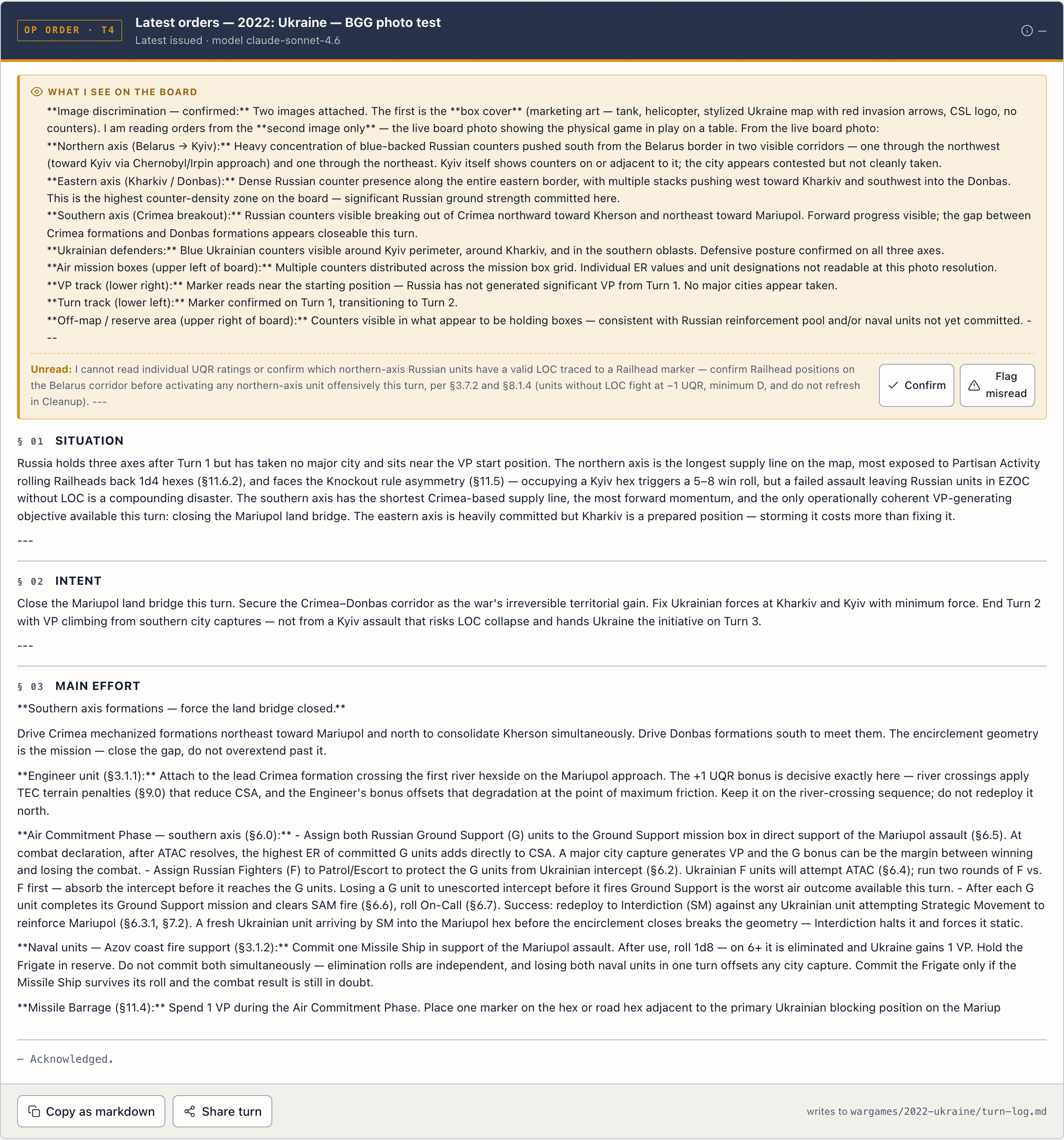
Wargamer mode generating orders for an in-progress campaign.
Kriegsspiel mode
A live umpire for the kriegsspiel hobby at hammerstein.ai/kriegsspiel. Set a scenario, enter both sides' orders each turn, and Hammerstein resolves it. Switch to Rules Q&A instead of looking up rules manually. Ships with SCKA Advanced, K22, K23 ACW, and Tschischwitz 1862.
Matrix mode
Hammerstein as referee for Chris Engle's Classical Matrix Game at hammerstein.ai/matrix. Submit each player's argument; Hammerstein rules on it against Engle's strength table with the same verification-gate discipline as the other modes. Roll your own dice and type the result, or let the table roll them for you. Both are honest, and either way the roll is shown.
The GM that does not say yes.
Hammerstein runs the rules and the world. You play your character.
Rolls are real and shown. State is kept, inventory, wounds, counters. Bad plans can fail. No yes-anding, no ten-paragraph scenery, no amnesia at turn eleven.
Chat mode
A persistent Hammerstein strategy room at hammerstein.ai/chat. Paste a plan, draft a question, or open an old thread. Replies stream as written, and the sidebar keeps every conversation. Regular and Lifetime subscribers.
Why you can trust it
- Every ruling cites the rule and the page. When your rulebook doesn't cover the situation, Hammerstein says so instead of guessing.
- Dice are real and checkable. RPG mode rolls off a seeded tape you can verify after the fact; Matrix mode now offers the same table-rolled dice as an option, alongside rolling your own.
- Your campaign is yours. It's stored to power your saved games and nothing else. Never sold, never used to train anything.
Pricing
Free tier: every mode in your browser, no card required. Wargamer gives you 25 turns a day, Kriegsspiel gives you 25 rules questions and 5 umpire turns a day, Matrix gives you 5 turns a day. Chat is subscriber-only.
Pick what fits. Cancel anytime. Hammerstein runs in your browser, no install, no API key.
Already subscribed? Manage subscription — cancel, update payment, view invoices.
FAQ
- Will it just make up rules?
- No. When you supply a rulebook, Hammerstein cites the rule and the page. When the rulebook lacks coverage for your situation, it says so plainly instead of inventing an answer. That legible failure is deliberate. The framework is tuned to refuse when the source material does not support a claim.
- Does it work for [insert specific tabletop wargame here]?
- If you can photograph the board and describe the rules, yes. The optional rulebook PDF gets digested into an AI Commander Reference for that specific game. Tested on hex-and-counter, area-movement, card-driven, and block-and-counter games so far, including full turns run and verified against 2022: Ukraine, Sedan 1940, and TWU: East Prussia.
- What does "Auftragstaktik" mean?
- Mission-type tactics. Orders that specify the intent, not the script — what the higher echelon wants accomplished, with the latitude given to subordinates to figure out how. The model produces orders in this register specifically because it's the doctrine I'm tuned to.
- What happens when the AI behind it changes?
- AI models change release over release. Hammerstein is a discipline layer that sits above whichever engine is running underneath it. When the engine changes, the rules of conduct don't: it still cites the rule and the page, still refuses to invent one, still says plainly when it doesn't know. For the curious, there's a public benchmark measuring exactly this at /under-the-hood.
- Is this multiplayer?
- No. Single-player at MVP — you against the model, or you using the model as your subordinate-orders generator while you play either side solo. Multiplayer is a future tier.
- What about my campaign data?
- Stored per-account, used only to power the persistent-context feature for your campaigns. Not shared, not sold, not used to train any model. You can delete a campaign and its data is gone.
- Refund policy?
- Cancel anytime; no refund on the current month, but no future charges. If something is genuinely broken on my end, email and we'll work it out.
- Who's behind this?
- Ray Weiss, designer at Conflict Simulations LLC. The framework is named after Kurt von Hammerstein-Equord, the German general whose doctrine the project is tuned to.
Roadmap
- Coming next: a mobile-first layout for the Sources panel, so the whole thing works properly on the phone or tablet you actually bring to the table.
- After that: voice in, voice out.
- Then: a desktop hotkey app, and rule schemas tuned for specific game families like Twilight Struggle and the Pax Pamir series.
The full build log, plus the open-source framework and the coding benchmark, live at /under-the-hood.